> For the complete documentation index, see [llms.txt](https://docs.forestall.io/forestall/llms.txt). Markdown versions of documentation pages are available by appending `.md` to page URLs; this page is available as [Markdown](https://docs.forestall.io/forestall/unified-identities/azure-identities/entra-id/groups.md).
# Groups
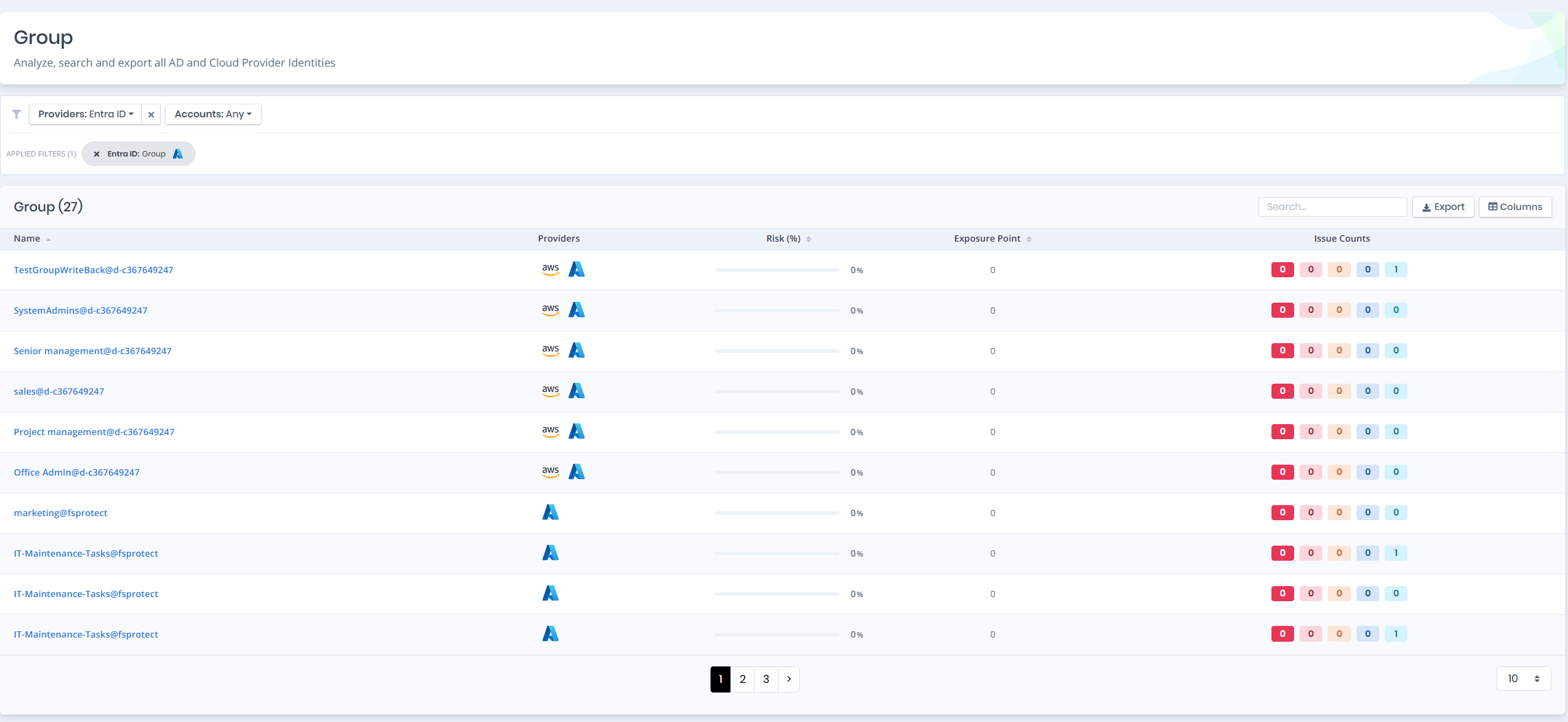
Open **Unified Identities › Group**, filter **Providers** to **Entra ID › Group**, then select a row to open its details.
Groups
## Group Details
Opening a group shows the `Risk` and `Exposure Point` in the header, and the page contains the `Information` and `Issues` panes.
{% hint style="info" %}
You can analyze the object in the [Graph](/forestall/visualize/visualize.md) by clicking the **Graph »** button next to the `Information` title. For a shadow admin the button reads **Admin Path »** and opens the shortest path to admin objects (see [Object Detail Pages](/forestall/unified-identities.md#object-detail-pages)).
{% endhint %}
Group Details
## Information
`Information Pane` can contain different badges to highlight important attributes.
| Badge | Description |
| ----------------------- | --------------------------------------------------------------------------------------------------------------------------------- |
| **Shadow** | Indicates that the object can compromise admin objects with at least one attack path. |
| **Privileged** | Indicates that the object is Privileged. |
| **ARM Privileged** | Indicates that the identity has at least one privileged Azure Resource Manager role assignment at resource group scope or higher. |
| **Tier 0** / **Tier 2** | Indicates the tier of the object. |
`Information Pane` contains `Details`, `Parent Groups`, `Child Groups`, `Child Users`, `Child Devices`, `Child Service Principals`, `Child Administrative Units`, `Owner Users`, `Owner Service Principals`, `ARM Roles` and `Policies` tabs respectively. Each tab carries the number of rows it holds in its label.
## Details
Details tab contains attributes below about group object.
| Attribute | Description |
| ------------------------- | ------------------------------------------------------------------------------------------------------------------------------------------------- |
| **Name** | The unique name or alias of the group, used for identification and referencing within Azure AD. |
| **Description** | A user-defined text field describing the group's purpose or membership. |
| **Display Name** | The name shown in the directory, often used in address books and group listings. |
| **Tenant** | The Entra ID tenant to which the group belongs, linking to its [Tenant](/forestall/unified-identities/azure-identities/entra-id/tenants.md) page. |
| **Security Enabled** | Indicates whether the group is a security group, which can be used to manage access to resources like SharePoint, Teams, or applications. |
| **Group Type** | Defines the type of group: **Security** for access control or **Microsoft 365** for collaboration (this group is a **Security group**). |
| **When Created** | The date and time when the group was created in the Azure Active Directory. |
| **Is Assignable To Role** | Indicates whether this group can be assigned to Azure AD roles (role-assignable groups must be security-enabled and marked as assignable). |
| **On Prem SID** | The security identifier (SID) for the group from the on-premises Active Directory, used during synchronization. |
| On Prem Sync Enabled | Specifies whether the group was synchronized from an on-premises Active Directory via Azure AD Connect. |
| Security Identifier | A unique SID assigned by Azure AD for the group object, used in access control and permissions. |
## Parent Groups
Parent Groups tab contains a list of groups that the group is a member of. This list also contains `Enabled` and `On Prem Sync Enabled` columns to identify the status of these groups.
Parent Groups
## Child Groups
Child Groups tab contains a list of groups that are members of the group. This list also contains `Enabled` and `On Prem Sync Enabled` columns to identify the status of these groups.
Child Groups
## Child Users
The Child Users tab displays a list of user accounts associated with the group.
Child Users
## Child Devices
The Child Devices tab displays a list of devices objects associated with the group.
Child Devices
## Child Service Principals
The Child Service Principals tab displays a list of Service Principals associated with the group.
Child Service Principals
**Name**: The name of the Service Principals.
**Enabled**: Indicates whether the Service Principals is active.
**App Display Name:** The display name of the Azure AD application that this service principal is associated with.
**Service Principal Type:** The type of the service principal, which defines its origin.
Common types include:
* `Application`: a service principal created for an Azure AD application.
* `ManagedIdentity`: for system- or user-assigned managed identities.
* `Legacy`: for older service principal objects.
* `Federated`: for service principals from external identity providers
## Child Administrative Units
The Child Administrative Units tab displays a list of Administrative Units associated with the group.
Child Administrative Units
**Display Name**: The display name of the Administrative Unit, used to identify it within Azure AD.
**Member Management Restricted**: Indicates whether non-global administrators are restricted from managing members of this Administrative Unit. When set to `true`, only scoped-role assignments can manage its members.
**Visibility**: Determines whether the Administrative Unit is visible to users in the directory. Values can be:
* `Public`: visible to all users.
* `HiddenMembership`: members are not visible to non-admin users.
* `Private`: not visible unless explicitly granted access.
## Owner Users
The Owner Users tab displays a list of Owner Users associated with the group.
Owner Users
## Owner Service Principals
Owner Service Principals tab contains a list of service principals that own the group.
Owner Service Principals
## ARM Roles
ARM Roles tab contains a list of the Azure Resource Manager role assignments held by the group, with `Type`, `Built In` and `Assigned` columns. Every member of the group inherits these, so a group with resource-plane roles widens the blast radius of each membership.
## Policies
Policies tab lists the Conditional Access policies that apply to the group.
**Name:** The policy the row is about, linking to its [Conditional Access Policy](/forestall/unified-identities/azure-identities/entra-id/conditional-access-policies.md) page.
**State:** Whether the policy is `Enabled`, `Disabled` or `Report-only`.
Because Conditional Access is usually assigned to groups rather than to individual users, this tab is the quickest way to see what a group actually grants or demands before changing its membership. [CAP Audit](/forestall/cap-audit.md) reports the same relationship from the policy side.
## Issues
Issues pane contains identified issues on the group object.